
Set wide the window or apply 9A
Did you know that a broken sash cord can render your home unfit for human habitation? A renter wrote to complain about a broken sash cord in the room she rented. As a London renter of longstanding, I also gave her some practical advice; prop the window on a hardback book or a stout stick.
But there is a knack to closing a window held open by a stick of wood or similar. Acquiring the knack is not without risk to fingers and hands. If the only window in a room cannot be opened or closed safely, without danger as you attempt the manoeuvre, it could be interpreted as rendering a property unfit for human habitation. The same is certainly true if the only window in a room doesn’t open or close at all.
This question came up again when a renter in one of those new-build blocks promising ‘hassle-free renting’ got in touch. The only window in her studio flat is sealed shut. There’s no window in the bathroom and the extractor fan is insufficient to ventilate both spaces. Her lengthy chain of correspondence with the management company has not helped; the window still does not open.
Under section 9A of the Landlord and Tenant Act 1985 — the amendment created by the Homes (Fitness for Human Habitation) Act — this unhappy renter could pursue the landlord through the court. That course of action is far from hassle-free, though. Alternatively, she could report the landlord to the local residential environmental health team. The council should force the landlord to fix the problem.
This all takes time and actually, she doesn’t want the hassle. Glad of the break clause in the tenancy agreement, her most recent email to the building managers was to give the required two months notice.
The Renters’ Rights Bill
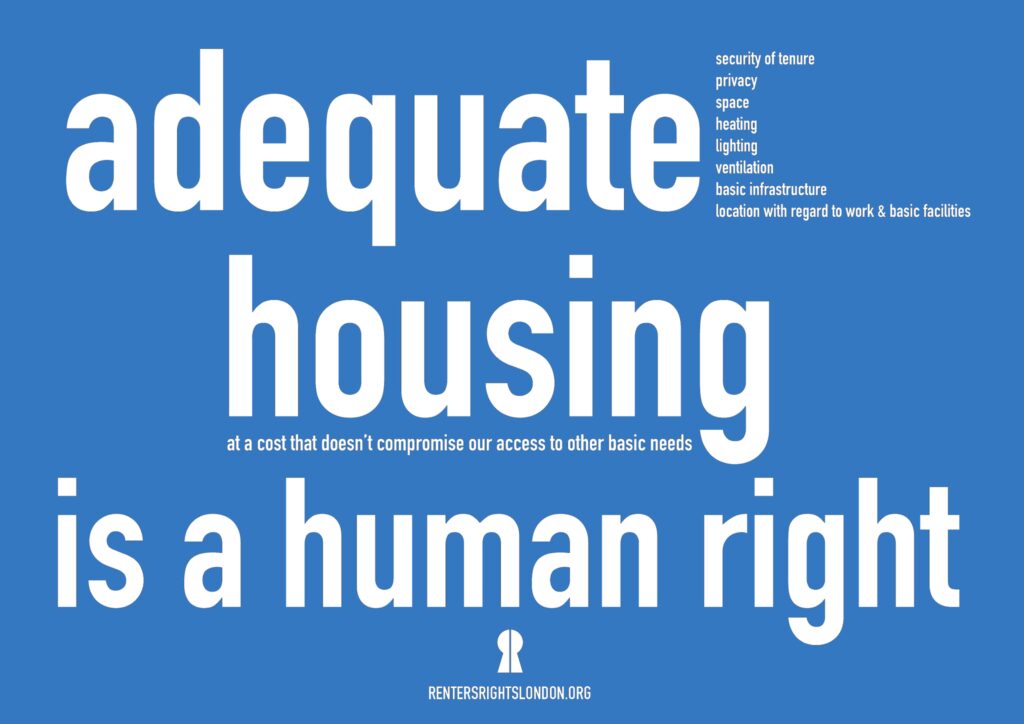
Tremendously well-titled, the Renters’ Rights Bill takes steps towards our right to adequate housing; essential to an adequate standard of living. The second reading is scheduled for Wednesday, 9 October so it’s progressing at a good pace.
At long last, abolition of eviction under Section 21 will happen. This is essential to real change so it’s most welcome. We can look forward to greater security of tenure under the new assured periodic tenancy. Although The Renters’ Rights Bill, as introduced, includes some new “no fault” grounds, penalties will be applied to any landlord caught abusing those.
Also, The Renters’ Rights Bill will require every landlord to register themselves and their properties on a Private Rented Sector Database. You’ll be able to see that the home you are about to rent is compliant with legal minimum requirements before entering into a contract. If major problems arise and are not addressed, it will be easier for the local authority (vested with even greater enforcement powers by this Bill) to find the landlord and take action.
Fixed-term tenancies will be a thing of the past. The (weak) protections offered by section 13 of the Housing Act 1988 are (slightly) strengthened by the Renters’ Rights Bill, therefore. Once in every 12 months, a landlord can give you one months notice of a proposed rent increase, by serving Form 4. If you act fast, you can challenge the proposed rent increase through the First-tier Tribunal. The Tribunal decides what rent the landlord could expect if the same tenancy were offered to the market. Once the Renters’ Rights Bill becomes law, the Tribunal will be able to order that the rent remains unchanged or increased by a smaller amount, or even that the rent should be reduced.
But there’s nothing in the Bill, as published, to challenge free market ideology. Landlords may still “have their cake and eat it at the renter’s expense“. In July 2024, average rent cost nearly 39% of average pay in London. That’s too much. And it’s an average. We know many renters who must give over 50% of their take home pay to a landlord. Obviously, so doing compromises their attainment of other basic needs. Perhaps a system which supports the transfer of wealth from those of us with less to the better off cannot also claim to defend our human right to an adequate standard of living.
While the Renters’ Rights Bill specifically outlaws discrimination against renters with children and renters in receipt of benefits, income checks will still be permitted. There’s no mention of scrapping ‘right to rent’ rules, either. Even the Supreme Court agreed that the right to rent scheme did, to an extent, increase the risk of some discrimination.
So, The Renters’ Rights Bill is imperfect but a very great improvement on the system in place today. As part of the Renters’ Reform Coalition, we contributed to the Roadmap for Reform, which goes into much greater detail about the changes which remain to be made.
Regulated Tenants
If yours is a Secure Tenancy, please contribute your wisdom to Dr Sharda Rozena’s research? As Sharda explained to the CFPT Annual General Meeting, she’s particularly interested because she grew up in a Secure Tenancy, here in London. If you know any regulated tenants, please invite them to email to contribute?

